CookBook Team
Types of pastry compared
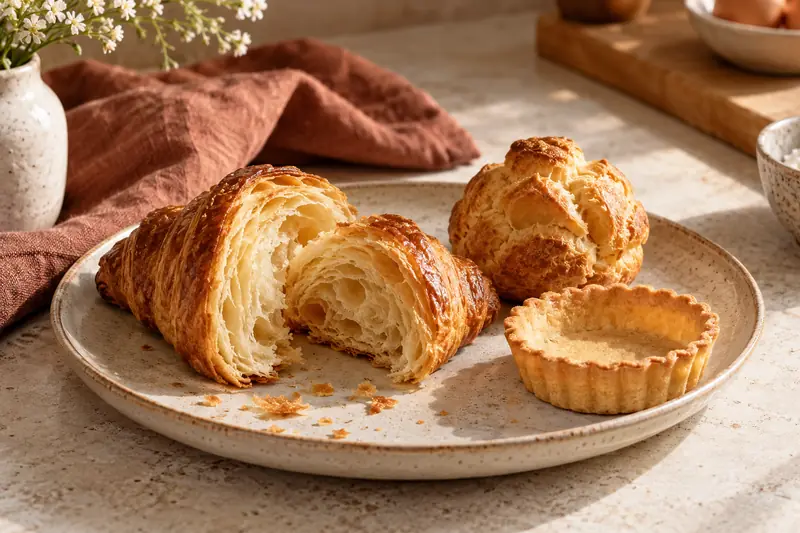
Pastry types differ mainly in how the fat is combined with the flour. Rubbed-in fat gives crumbly shortcrust, layered fat gives flaky puff, and cooked paste gives hollow choux.
CookBook TeamUpdated
Six pastries compared
Ratios are by weight, taken from the recipes cited below. They compare selected ingredients, not complete formulas: choux, for example, also needs eggs. Professional recipes vary, so treat these ratios as starting points and follow a complete recipe.
| Pastry | How the fat goes in | Typical ratio by weight | Texture | Typical uses |
|---|---|---|---|---|
| Shortcrust (pâte brisée) | Cold fat rubbed or cut into flour, then a little water | 2:1 flour to butter (Michelin), or 3:2:1 flour, fat, water (Ruhlman) | Crisp, crumbly to flaky | Quiche, fruit pies, chicken pie |
| Sweet pastry (pâte sucrée, sablée) | Butter creamed with sugar and egg, or rubbed into the flour | About 2:1 flour to butter, with sugar at 20–50% of the flour | Short and crumbly | Sweet tarts and tartlets |
| Puff (pâte feuilletée) | Butter block sealed in dough, then rolled and folded | Butter about 80–90% of the flour | Crisp, separate, flaky leaves | Napoleons, filled pastries, savoury pies |
| Rough puff | Cold butter flakes mixed in, then rolled and folded | Butter about 75–95% of the flour | Flaky, closer to a folded shortcrust | Turnovers, palmiers |
| Choux | Butter melted in boiling liquid, flour cooked in, eggs beaten in | Liquid about 1.5 times the flour; butter 60–75% of the flour | Crisp shell, hollow centre | Éclairs, profiteroles, gougères |
| Filo | Melted butter or oil brushed between sheets | Dough about 2:1 flour to water | Paper-thin, crisp layers | Baklava, spanakopita |
Shortcrust: two ratios in common use
Coating the flour with fat before the water goes in limits gluten, which keeps shortcrust tender. Sources disagree on how much fat to use:
- 2:1 flour to butter. The Michelin Guide pâte brisée uses 250 g flour, 125 g butter, an optional egg and a little water.
- 3:2:1 flour, fat, water. Michael Ruhlman's ratio, reported by NPR and The Splendid Table, puts fat at about 67% of the flour.
- 60–80% fat. King Arthur Baking recommends this range; its classic double crust uses 297 g flour to 188 g butter and shortening (63%).
Method essentials: keep the fat very cold, leave some pieces the size of a small coin for flakiness (King Arthur), add just enough cold water to bind, and chill before rolling.
Sweet pastry: sucrée and sablée
The names are used loosely. Michelin calls brisée plus 50 g sugar "pâte sucrée" and describes sablée as more crumbly, with icing sugar, soft butter and often ground almonds. Meilleur du Chef separates them by method: sucrée is creamed (200 g flour, 100 g butter, 80 g icing sugar, 1 egg) and sablée is rubbed in (250 g flour, 125 g butter, 125 g sugar, 1 egg plus 1 yolk). The French national baking institute INBP teaches both methods, aiming for minimal gluten, and recommends low-gluten flour and an overnight rest in the fridge to limit shrinking.
Puff and rough puff
Classic puff encloses a butter block in a lean dough (détrempe), then rolls and folds it. In the oven, steam trapped by the fat layers pushes them apart (BAKERpedia). King Arthur's classic puff pastry uses 570 g flour to 453 g butter (79%) and six letter folds; a French CAP pastry training sheet uses 500 g flour to 450 g butter (90%).
Rough puff flattens cold butter into flakes in the flour, then folds the rough, uneven dough. King Arthur's rough puff uses 360 g flour to 340 g butter with one letter fold and two book folds; the French sheet's quick version (feuilletage rapide) uses 500 g flour to 375 g butter.
Lamination and the layer maths
A turn is one roll and one fold. A letter fold (single turn, tour simple) folds the dough in thirds and triples the butter layers. A book fold (double turn, tour double) folds both ends to the centre, then in half, and multiplies them by four.
Starting from one butter layer between two of dough:
- Butter layers = 3^L × 4^B, where L is the number of letter folds and B the number of book folds
- Dough layers = butter layers + 1, because at each fold two dough surfaces meet and fuse
- Total layers = 2 × butter layers + 1
Worked layer counts
| Folds after lock-in | Butter layers | Dough layers | Total |
|---|---|---|---|
| 1 letter + 1 book | 12 | 13 | 25 |
| 3 letter (croissant) | 27 | 28 | 55 |
| 1 letter + 2 book (rough puff, notional) | 48 | 49 | 97 |
| 4 letter | 81 | 82 | 163 |
| 4 book | 256 | 257 | 513 |
| 6 letter (classic puff) | 729 | 730 | 1,459 |
Rough puff counts are notional, because its butter starts as scattered flakes. Published counts differ because writers count different things. King Arthur counts both: 163 layers for four letter folds and 25 for a letter plus a book fold. Wikipedia gives 729 butter, 730 dough and 1,459 in total for six turns; many recipes quote only 729. America's Test Kitchen counts 3 to the power of the turns from a single sheet, and found layers fused beyond eight turns. The French training sheet counts a double turn as 1.5 turns, so "5 turns" can mean several sequences.
Choux
Choux is cooked twice. Boil the liquid and butter, add the flour at once, and stir over the heat until the paste leaves the pan and a film forms on the base. Cool it to below 52 °C (125 °F) (King Arthur), then beat in the eggs gradually until the paste is glossy and a line drawn through it closes slowly (Meilleur du Chef: 250 g milk and water, 100 g butter, 165 g flour, 250 g egg). Cooking pre-gelatinises the starch, so the paste holds more water to turn into steam. Moist walls collapse, so bake until a test shell is dry inside.
Filo
Filo is a lean dough of flour, water and salt, sometimes with egg or vinegar, stretched until you can see through it (Exploratorium). Gourmet Traveller uses 500 g flour to 250 ml water and brushes the sheets with 200 g melted butter. Keep unused sheets covered: they dry and tear quickly.
Blind baking
Blind baking sets and browns a case before a wet or unbaked filling goes in: fully for fillings that never go back in the oven, partly for custards that bake briefly (King Arthur). King Arthur's method: chill the lined pan for 30 minutes, cover the pastry with parchment or foil, fill with weights, beans or rice, and bake at 190 °C (375 °F) for 20 minutes. For a full bake, remove the weights, prick the base and bake 20–25 minutes more.
Shrinking, puffing and a soggy base
| Problem | Usual causes | Prevention |
|---|---|---|
| Shrinking or slumping | Overworked or stretched dough, too much or too warm fat, too little rest | Roll gently, do not stretch, chill before baking, use weights |
| Puffing | Bubbles forming under an unpricked, unweighted base | Prick (dock) the base and fill with weights |
| Soggy base | Underbaked pastry under a wet filling | Prebake; seal with melted chocolate, or egg yolk and cream brushed on 5 minutes before the end (INBP) |
Key temperatures
Lamination needs dough and butter equally pliable: over-chilled butter fractures, warm butter melts (King Arthur workbook). Oven settings vary widely between sources; the oven temperature converter includes a fan-oven adjustment.
| Stage | Temperature | Source |
|---|---|---|
| Puff dough while laminating | 2–7 °C (35–45 °F) | King Arthur |
| Puff butter block | 16–21 °C (60–70 °F); 16 °C (61 °F) | King Arthur; BAKERpedia |
| Shortcrust blind bake | 190 °C (375 °F); 218 °C (425 °F) | King Arthur prebake guide; lemon meringue pie |
| Sweet tart shells | About 155 °C (311 °F), down from about 180 °C (356 °F) | INBP |
| Puff and rough puff | 204 °C (400 °F); 190 °C (374 °F) falling to 170 °C (338 °F); 176 °C (349 °F) convection | King Arthur; French training sheet; BAKERpedia |
| Choux | 218 °C (425 °F) for 15 minutes, then 177 °C (350 °F); or 170 °C (338 °F) fan | King Arthur; Meilleur du Chef |
Related guides and tools
Topping a tart? Compare French, Swiss and Italian meringue. Filling a sweet case with chocolate? Use the ganache ratio calculator. Changing tart tin size? Scale with the baking pan size converter. Converting a recipe from cups? Check the ingredient weight chart.
Keep your pastry recipes together
CookBook saves recipes from websites, social posts, photos and cookbooks and keeps them organised. In cooking mode you can change the servings and the measurement system; ingredient amounts scale, but baking times do not, so check the pastry as it bakes.
Sources
- Guide MICHELIN: Réviser ses classiques, la recette de la pâte brisée parfaite
- NPR: Throw away the recipe; learn the ratio instead
- The Splendid Table: Pie dough ratio
- King Arthur Baking: Pie crust guide
- King Arthur Baking: How to keep pie crust from shrinking
- King Arthur Baking: How to prebake pie crust
- King Arthur Baking: Classic lemon meringue pie
- Meilleur du Chef: Pâte sucrée
- Meilleur du Chef: Pâte sablée
- INBP: Techniques de pâtisserie, rappels et évolutions (PDF)
- BAKERpedia: Puff pastry
- King Arthur Baking: Classic puff pastry (pâte feuilletée)
- Académie de Versailles: Fiche d'analyse technique, la pâte feuilletée (PDF)
- King Arthur Baking: Rough puff pastry
- King Arthur Baking: Fewer folds make better croissants
- Wikipedia: Puff pastry
- America's Test Kitchen: Exponentially upping the flakes in pastry
- King Arthur Baking: Pâte à choux
- Meilleur du Chef: Pâte à choux
- King Arthur Baking: What is pâte à choux?
- King Arthur Baking: Cream puffs and éclairs
- Exploratorium: Science of Cooking, Ask the Inquisitive Cooks
- Gourmet Traveller: How to make filo pastry
- King Arthur Baking School: Laminated baking workbook (PDF)
A little more help
Frequently asked questions
Is pâte brisée the same as shortcrust pastry?
Broadly, yes. Pâte brisée is the French form of shortcrust: cold fat worked into flour and bound with a little water, sometimes with an egg. French recipes such as the Michelin Guide's use half as much butter as flour, while American pie doughs often carry more fat, around two parts fat to three parts flour.
How many turns does puff pastry need?
Usually four to six single turns. BAKERpedia gives a minimum of four and a maximum of six single folds, King Arthur Baking's classic recipe uses six letter folds, and a French CAP training sheet says puff pastry generally gets five turns, counting a double turn as one and a half. Rest the dough in the fridge after every two turns or so, so the butter stays firm.
Do I need ceramic pie weights to blind bake?
No. King Arthur Baking lists dried beans, uncooked rice and granulated sugar as alternatives, poured onto a liner of parchment, foil or a paper coffee filter until the case is about two-thirds full. If the sides still slip, it suggests baking the lined case upside down between two identical pie pans for the first 20 minutes.
Why did my choux buns collapse after baking?
Usually because the walls were still moist when they left the oven. As the shells cool, the steam inside condenses and wet walls fall in. King Arthur Baking suggests breaking open a test shell to check it is dry before taking out the batch, and its cream puff recipe slits each shell and returns it to the oven for 5 minutes to let the steam escape.
Can I freeze homemade puff or rough puff pastry?
Yes. King Arthur Baking freezes its rough puff for up to 1 month and its blitz puff for up to 3 months, well wrapped, then thaws it overnight in the fridge before rolling.
Still have a question? Visit our help centre.
Cite this page
Referencing these numbers or explanations? Copy this citation and link to the page.
“Types of pastry compared”, CookBook Manager. Updated . https://cookbookmanager.com/guides/types-of-pastry
Text, tables and data on this page are available under the Creative Commons Attribution 4.0 licence (CC BY 4.0). Credit CookBook Manager and link to this page when you reuse them.