Fresh pasta: ratios, rolling and troubleshooting
For a repeatable pasta dough, weigh the flour, choose an egg or flour-and-water method and give the dough time to rest before rolling. These reference batches help you choose and scale the right method.
CookBook TeamUpdated
Choose egg pasta or flour-and-water pasta
Use egg dough for rolled sheets and ribbons, or durum flour and water for a firm dough that suits hand-shaped pasta. Start by weight and follow the method for your flour [1][2].
| Dough | Starting batch | Useful for |
|---|---|---|
| Egg dough | 280 g all-purpose flour, 3 large eggs and ½ tsp table salt | Rolled sheets and ribbons [1] |
| Eggless durum dough | 400 g durum flour, 200 g water and ¼ tsp table salt | Hand-shaped pasta such as cavatelli [2] |
The egg batch uses a whole-egg count, not a fixed hydration: egg size affects the liquid you add. The eggless batch is 50% hydration by flour weight, because 200 ÷ 400 × 100 = 50. Finely milled durum flour and coarse semolina can handle differently; use the flour your chosen method specifies.
Scale a batch without guessing the egg
| Batch | Egg dough | Eggless dough |
|---|---|---|
| Half | 140 g flour; beat 3 eggs together and weigh out half; ¼ tsp table salt | 200 g durum flour + 100 g water + ⅛ tsp table salt |
| Standard | 280 g flour + 3 large eggs + ½ tsp table salt | 400 g durum flour + 200 g water + ¼ tsp table salt |
| Double | 560 g flour + 6 large eggs + 1 tsp table salt | 800 g durum flour + 400 g water + ½ tsp table salt |
The salt amounts scale with the flour. When halving an egg batch, beat the eggs before dividing by weight; do not guess which part of an egg to leave out. The servings calculator handles another batch size. Pasta dough weight is not the same as the amount of sauce or the number of portions a person will eat.
Mix, knead and rest
- Weigh the flour and mix in the salt. Add the eggs or water gradually and gather the mixture into a dough.
- Knead until the dough holds together and becomes smooth. Avoid burying a sticky dough in extra flour.
- For the egg dough, cover tightly and rest for at least 30 minutes at room temperature before rolling. Work in small pieces and keep the unused dough covered.
- For the eggless durum formula, knead for about 10 minutes and rest covered for 15 to 20 minutes before shaping. Use water at about 43 to 49 °C (110 to 120 °F) for this formula.
The warm-water method is specific to that eggless formula [2]. The egg dough’s covered rest helps it roll without springing back [1]. A dough that springs back while rolling usually needs another short covered rest, rather than more force.
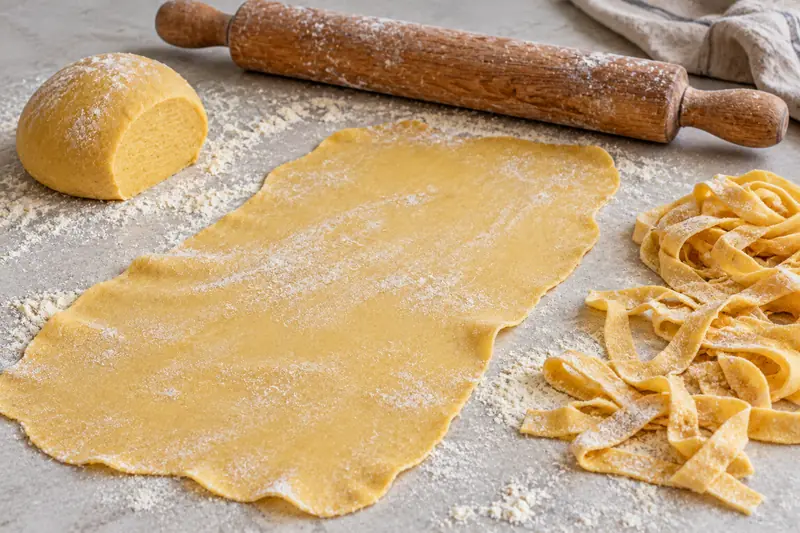
Roll gradually and keep the thickness even
Flatten a small piece and begin at the widest machine setting, or roll from the centre outwards by hand. Reduce thickness in stages. Dust only enough to prevent sticking, support long sheets and keep the rest covered [3].
| What you see | What to do |
|---|---|
| Sheet contracts after rolling | Cover and rest briefly before rolling again. |
| Crumbly edges that will not join | Work in a few drops of water, then knead and rest. |
| Dough sticks to the rollers or bench | Use a light dusting of flour; avoid a thick coating. |
| Sheet tears at thin settings | Return to a thicker setting and reduce in smaller steps. |
| Uneven cooking | Cut and roll the batch to a similar thickness. |
Cook promptly and store safely
Boil fresh pasta in salted water and test a piece rather than using dried-pasta packet timings. The reference egg dough cut into ribbons cooks in about 3 to 4 minutes [1]. The eggless reference batch cooks in about 3 to 5 minutes; shape and thickness change the time [2]. Toss with the sauce when the pasta is ready. The sauce guide explains the main sauce families.
Keep raw egg dough covered and refrigerated if you are not cooking it promptly. For shelf drying, choose a suitable eggless method and follow its complete drying instructions; do not assume a room-temperature nest of egg pasta is safely shelf-stable [4]. Freeze portions for longer storage using your recipe’s instructions.
Keep the formula that worked
Save the full recipe in CookBook with its flour type, egg count, resting method and the rolling setting that suited the shape. Keep these details when changing servings. Use the ingredient weight chart when converting a source that only gives cups, then weigh the flour for repeat batches.
Sources
A little more help
Frequently asked questions
Is every 00 flour a pasta flour?
No. 00 describes a milling classification, not one fixed protein level or one recipe. Choose a flour suited to the pasta method you are following.
Can I dry fresh egg pasta on the counter for storage?
Do not assume it becomes shelf-stable. For shelf drying, follow a suitable eggless method with complete drying instructions. Refrigerate or freeze egg dough according to its recipe.
Still have a question? Visit our help centre.
Cite this page
Referencing these numbers or explanations? Copy this citation and link to the page.
“Fresh pasta: ratios, rolling and troubleshooting”, CookBook Manager. Updated . https://cookbookmanager.com/guides/fresh-pasta
Text, tables and data on this page are available under the Creative Commons Attribution 4.0 licence (CC BY 4.0). Credit CookBook Manager and link to this page when you reuse them.
Keep reading
- Dough hydration explained
- Poolish, biga and levain compared
- Caramelization explained
- Maillard reaction vs caramelization
- Sugar syrup stages and temperatures
- Types of pastry compared
- French, Swiss and Italian meringue compared
- Bread proofing: temperature and readiness
- Cold-fermentation pizza dough guide
- Mother sauces, roux ratios and practical fixes