CookBook Team
French, Swiss and Italian meringue compared
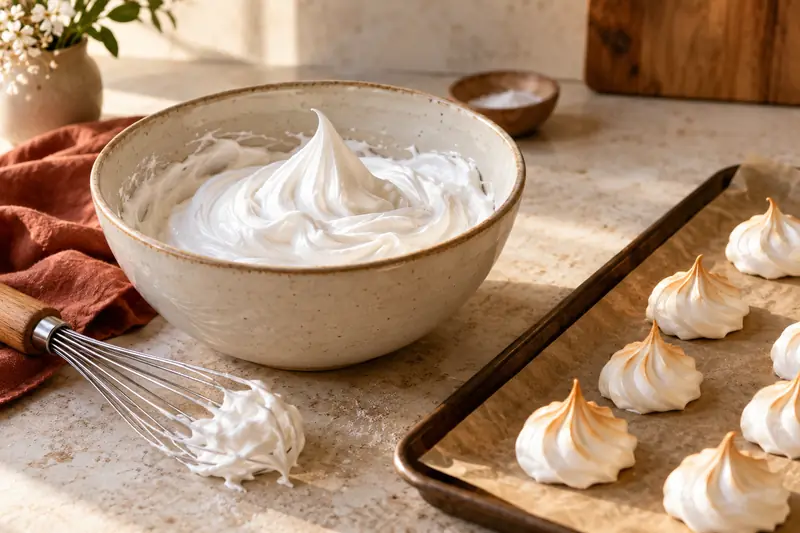
French meringue whips raw egg whites with sugar, Swiss meringue heats whites and sugar together first, and Italian meringue whips in a hot sugar syrup.
CookBook TeamUpdated
French, Swiss and Italian meringue at a glance
All three are egg white foams stabilised with sugar. They differ in when, and whether, heat is applied. Ratios are sugar to egg white by weight, from the recipes cited below.
| Feature | French | Swiss | Italian |
|---|---|---|---|
| Method | Raw whites whipped, sugar added gradually | Whites and sugar whisked over simmering water, then whipped until cool | Hot sugar syrup poured into whipping whites, then whipped until cool |
| Sugar to egg white | About 0.6:1 (soft topping) to 2:1 (crisp baked) | 1.5:1 to 2:1 | About 2:1 |
| Temperature reached | None until baked | 40–82 °C (104–180 °F), depending on the source | Syrup at 112–121 °C (234–250 °F) |
| Stability | Least stable | More stable than French | Most stable |
| Texture | Light | Satiny and fine | Glossy, fine, high volume |
| Typical uses | Baked meringues, pavlova, folding into batters, pie topping | Buttercream, pie and cake toppings, baked decorations | Buttercream, mousses, marshmallows, piped toppings |
Sugar ratios by weight
Ratio = sugar (g) ÷ egg white (g). To scale: sugar (g) = egg white (g) × ratio. King Arthur Baking weighs 3 large whites at 105 g, so a 2:1 meringue from 3 whites needs 105 × 2 = 210 g sugar. Published recipes:
| Recipe | Sugar | Egg white | Ratio |
|---|---|---|---|
| American Society of Baking, cold-method formula | 60 g | 100 g | 0.6:1 |
| King Arthur, baked French meringues | 418 g | 198–227 g | 1.8–2.1:1 |
| King Arthur, Swiss meringue | 173 g | 113 g | 1.5:1 |
| Meilleur du Chef, Swiss meringue | 250 g | 125 g | 2:1 |
| King Arthur, Swiss meringue buttercream | 248 g | 105 g | 2.4:1 |
| Great British Chefs, Italian meringue | 100 g | 50 g | 2:1 |
| Meilleur du Chef, Italian meringue | 400 g | 200 g | 2:1 |
Meringues meant to dry in the oven carry more sugar: Ricardo puts twice as much in a hard meringue as in a soft one.
Method essentials
French meringue
Use a clean, grease-free metal, glass or ceramic bowl: any yolk or fat stops the whites foaming (King Arthur). Room-temperature whites, 20–22 °C (68–72 °F), whip faster. Add the sugar gradually once the whites hold soft peaks, then whip to stiff peaks; a little cream of tartar, lemon juice or vinegar stabilises the foam. Bake low and slow: King Arthur uses 93–121 °C (200–250 °F) for about 2 hours, Meilleur du Chef 120 °C (248 °F) for 75–90 minutes.
Swiss meringue
Whisk the whites and sugar constantly over barely simmering water until the sugar has dissolved and the mixture reaches your target temperature, then whip at high speed until thick and cool. Sources disagree by more than 30 °C (54 °F) on the target (see the table below). King Arthur's Swiss meringue goes to at least 71 °C (160 °F) and no more than 82 °C (180 °F).
Italian meringue
Cook sugar and water to the target without stirring once the sugar dissolves, while the whites whip. Pour the syrup in a thin stream down the side of the bowl, away from the whisk, and keep whipping until the meringue cools. Most targets sit between what Chelsea Sugar calls soft ball, 115 °C (239 °F), and hard ball, 121 °C (250 °F), which is the firm-ball stage in the sugar syrup stages chart. Meilleur du Chef takes the pan off at 118 °C (244 °F) and lets the syrup keep rising to 121 °C (250 °F).
Published temperature targets
| Source | Swiss: whites and sugar heated to | Italian: syrup cooked to |
|---|---|---|
| Meilleur du Chef | 40–45 °C (104–113 °F) | 121 °C (250 °F) |
| Ricardo | 50–55 °C (122–130 °F) | 112–120 °C (234–248 °F) |
| Culinary Institute of America | 60 °C (140 °F) | 116 °C (240 °F) |
| King Arthur Baking | 71–82 °C (160–180 °F); 72 °C (161 °F) for buttercream | 116–121 °C (240–250 °F) |
| Great British Chefs | Not given | 121 °C (250 °F) |
| American Society of Baking | Not given | 121 °C (250 °F) |
Ricardo prints 112 °C alongside 236 °F at the lower end of its Italian syrup range. Those values are not equivalent; the table above keeps its Celsius figure and converts it to 234 °F.
Egg safety: which meringues reach 71 °C (160 °F)
The USDA Food Safety and Inspection Service (FSIS) says egg mixtures are safe once they reach 71 °C (160 °F), the figure FoodSafety.gov also gives for egg dishes. Separated egg white sets at 60–65 °C (140–149 °F) (BCcampus), so whisk Swiss meringue constantly as it heats.
- French: raw until baked. FSIS treats dry meringue shells as safe and meringue-topped pies as safe if baked at 177 °C (350 °F) for about 15 minutes. It advises against icings and chiffon pies made with raw whites.
- Swiss: reaches 71 °C only at King Arthur's target. The 40–60 °C (104–140 °F) targets do not, although the Culinary Institute of America describes its 60 °C version as safe to eat. To follow FSIS, heat to 71 °C and check with a thermometer.
- Italian: the syrup is far hotter than 71 °C, and the CIA and Great British Chefs describe the whites as cooked by it. FSIS does not name Italian meringue, but it lists divinity and 7-minute frosting, which it describes as hot sugar syrup combined with beaten egg whites, as safe. If you need certainty, check that the meringue reaches 71 °C.
- Any type: FSIS recommends pasteurised eggs or egg products when eggs will be eaten raw or undercooked.
Troubleshooting
| Problem | Likely cause | Fix |
|---|---|---|
| Weeping (liquid under a pie topping) | Underbaked: the inside never got hot enough to set | Spread onto hot filling so the base cooks; add cornstarch |
| Beading (droplets on top) | Overbaking squeezes moisture out of the surface | Bake more gently; Ricardo uses 163 °C (325 °F) for 20–25 minutes for 4 or more whites |
| Grainy or gritty | Granulated sugar not dissolved | Use superfine sugar, add it gradually, or dissolve it first (Swiss) |
| Will not whip or deflates | Fat or yolk in the whites, a greasy plastic bowl, sugar added too early, no acid | Clean bowl; add sugar after soft peaks; add cream of tartar |
| Dull and lumpy | Overwhipped | For French meringue that will be baked, the CIA suggests adding another egg white and whipping again. Do not add raw white to a cooked meringue intended to be eaten without further cooking; start again instead. |
| Sticky baked meringues | Humid weather; no stabiliser | Allow longer drying; add cream of tartar; store airtight |
Weeping and beading causes follow Ricardo; the cornstarch fix appears in both Ricardo and King Arthur.
Soft peaks vs stiff peaks
The CIA's definitions: at soft peaks the foam clings to the whisk but forms no point; at medium peaks a peak forms and droops at the tip; at stiff peaks it stands in a sharp point. Add sugar from soft peaks. King Arthur whips Swiss meringue to medium-stiff peaks and baked meringues to stiff peaks.
Meringue buttercreams
Swiss and Italian meringue are the base of the buttercreams named after them. King Arthur's Swiss meringue buttercream heats 105 g whites with 248 g sugar to 72 °C (161 °F), whips until the bowl is barely warm, then beats in 454 g butter at 18 °C (65 °F) or warmer, a little at a time. Its Italian buttercream whips the meringue down to 27 °C (80 °F) before the butter goes in. Both can look curdled halfway: keep beating. If the buttercream is soft, chill it for 15 minutes and whip again.
Related guides
For syrup temperatures and cold-water tests, see sugar syrup stages. For the tart case under a meringue topping, see types of pastry compared.
Keep your meringue recipes together
CookBook saves recipes from websites, social posts, photos and cookbooks and keeps them organised. In cooking mode you can change the servings and the measurement system; ingredient amounts scale, but cooking times do not.
Sources
- USDA Food Safety and Inspection Service: Shell eggs from farm to table
- FoodSafety.gov: Safe minimum internal temperatures
- BCcampus, Modern Pastry and Plated Dessert Techniques: Coagulation
- Culinary Institute of America, CIA Foodies: All about meringues
- Ricardo: Your guide to French, Swiss and Italian meringue
- Ricardo: How to keep a meringue pie from weeping
- American Society of Baking: Meringue
- King Arthur Baking: Meringue rules
- King Arthur Baking: What's the best way to make meringue?
- King Arthur Baking: Meringues
- King Arthur Baking: Swiss meringue
- King Arthur Baking: Swiss meringue buttercream
- King Arthur Baking: Italian buttercream
- Meilleur du Chef: Meringue française
- Meilleur du Chef: Meringue suisse
- Meilleur du Chef: Meringue italienne
- Great British Chefs: How to make Italian meringue
- Chelsea Sugar: Italian meringue
A little more help
Frequently asked questions
Do I need cream of tartar to make meringue?
It is not essential, but it helps. In a King Arthur Baking comparison, meringue with no stabiliser stayed soft, never held a truly stiff peak and turned chewy overnight, while cream of tartar gave the most volume and stayed crisp. Lemon juice or white vinegar worked almost as well. Suggested amounts differ: King Arthur uses 1/8 teaspoon per large egg white, the Culinary Institute of America 1/8 teaspoon per two whites.
Why are my baked meringues sticky the next day?
Sugar draws moisture from the air, so meringues dry slowly and soften again on humid days, and meringues made without an acid stabiliser turned chewy overnight in King Arthur Baking's comparison. Dry them fully and store them airtight once cool: King Arthur keeps baked Swiss meringues for up to 2 weeks, while Meilleur du Chef suggests 4 to 6 weeks for dry Swiss meringue decorations.
Which meringue is best for lemon meringue pie?
Swiss and Italian meringue are the most stable, which the Culinary Institute of America says makes them the best choice for toppings. French meringue also works when it goes onto hot filling and bakes through: USDA considers meringue-topped pies safe when baked at 177 °C (350 °F) for about 15 minutes.
Can I use carton or dried egg whites for meringue?
Pasteurised egg products are what USDA recommends when eggs will be eaten raw or undercooked. The American Society of Baking says dried egg whites should be reconstituted following the manufacturer's instructions, and King Arthur Baking's Italian buttercream is written for meringue powder, with fresh whites as an alternative. Check the pack to see whether the maker recommends the product for whipping.
Can I make Italian meringue without a thermometer?
It is possible but harder to repeat. The syrup target is narrow, roughly 116–121 °C (240–250 °F), around the firm-ball stage, so a cold-water test can get you close. The sugar syrup stages guide explains how to do the test. Meilleur du Chef recommends an electronic probe thermometer.
Still have a question? Visit our help centre.
Cite this page
Referencing these numbers or explanations? Copy this citation and link to the page.
“French, Swiss and Italian meringue compared”, CookBook Manager. Updated . https://cookbookmanager.com/guides/meringue-types
Text, tables and data on this page are available under the Creative Commons Attribution 4.0 licence (CC BY 4.0). Credit CookBook Manager and link to this page when you reuse them.