CookBook Team
Caramelization explained
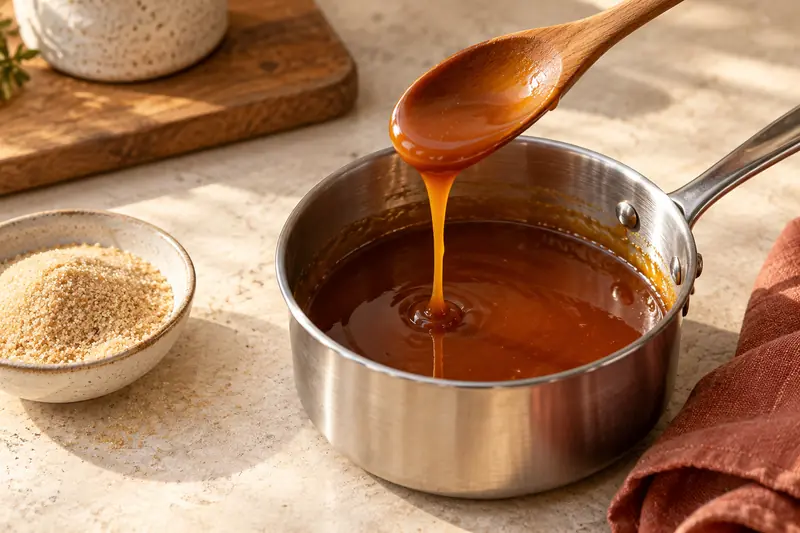
Caramelization is the browning of sugars by heat alone, which creates new colours, aromas and flavours. Table sugar starts to colour at roughly 160–170 °C (320–338 °F), depending on the source and on how long it is heated.
CookBook TeamUpdated
What caramelization means
Caramelization is the browning of sugar by heat, with no protein involved. It turns colourless sugar into brown pigments and aroma compounds that taste buttery, nutty and, as it darkens, bitter. Like the Maillard reaction it is non-enzymatic browning, but the Maillard reaction needs amino acids as well as sugar, while caramelization uses sugar alone (American Society of Baking; University of Guelph).
The browning on seared meat is the Maillard reaction, not caramelization (Encyclopedia of Food and Culture). Chewy caramel sweets can involve either or both processes: cooking sugar with cream allows Maillard browning (Exploratorium), while other recipes first caramelize the sugar, then add cream. ThermoWorks describes this second method, heating the sugar to 177 °C (350 °F) before adding cream and finishing at 120 °C (248 °F).
The chemistry in plain words
Heat does not simply melt sucrose (table sugar) and then brown it. University of Illinois researchers found that sucrose crystals give way because the molecules are already breaking down, which they called “apparent melting”. The temperature at which it happened changed with the heating rate, glucose and fructose behaved the same way, and breakdown products such as glucose and hydroxymethylfurfural (HMF) appeared as soon as the crystals collapsed. Because the breakdown depends on time as well as temperature, sugar held for longer can caramelize well below the melting point usually quoted for sucrose.
Once sugar starts to break down, many reactions run side by side (University of Guelph):
- Splitting: sucrose breaks into its two halves, glucose and fructose, a step called inversion.
- Losing water: the sugars condense and dehydrate, giving off water as they go.
- Breaking apart: as the water content falls, molecules fragment into small, volatile aroma compounds. Diacetyl gives a buttery, butterscotch note and furans taste nutty.
- Building up: other fragments join into large brown polymers called caramelans, caramelens and caramelins, which give caramel its colour.
The finished caramel holds traces of up to about a hundred sweet, sour and bitter compounds (Encyclopedia of Food and Culture), and food scientists still do not understand every step (Exploratorium).
When different sugars start to caramelize
Each sugar starts to brown at a different temperature. Treat these figures as approximate starting points, not melting points: the onset falls when sugar is held for longer, shifts with pH and other ingredients, and varies between sources (University of Illinois; University of Guelph).
| Sugar | Approximate onset | Where sources differ |
|---|---|---|
| Fructose (fruit sugar) | 110 °C (230 °F) | University of Guelph: 110 °C. American Society of Baking: 150 °C (302 °F). Both rank it first among common sugars. |
| Glucose (dextrose) | 150 °C (302 °F) | University of Guelph. The American Society of Baking ranks it second, after fructose. |
| Sucrose (table sugar) | 160–170 °C (320–338 °F) | University of Guelph and Exploratorium: about 170 °C (338 °F). NIST and King Arthur Baking start the caramel stage at 160 °C (320 °F); the Encyclopedia of Food and Culture says about 154 °C (310 °F). |
| Maltose (malt sugar) | 180 °C (356 °F) | University of Guelph and American Society of Baking agree. |
In practice, fructose-rich honey browns sooner and darker than table sugar (Encyclopedia of Food and Culture; American Society of Baking).
Colour and flavour stages of caramel
As sucrose caramel cooks it moves from clear to gold, amber, deep brown and finally black. Flavour follows colour: caramel that is too light lacks flavour, and caramel that is too dark tastes burnt and bitter (King Arthur Baking). Published temperatures for each colour differ by 10 °C (18 °F) or more, so judge by colour and smell as well as the thermometer.
| Stage | What you see and taste | Exploratorium | Encyclopedia of Food and Culture |
|---|---|---|---|
| Colour begins | Almost no water left; clear to faintly coloured, little change in flavour | 160 °C (320 °F): liquid, light amber | 154–168 °C (310–334 °F): browning begins, slight colour |
| Light caramel | Pale amber to golden; richer, rounder flavour | 170 °C (338 °F): turns brown, richer flavour | 180 °C (356 °F): pale amber to golden brown |
| Medium caramel | Golden brown to chestnut; full caramel flavour | Not listed separately | 180–188 °C (356–370 °F) |
| Dark caramel | Very dark, bitter, smells burnt; little sweetness left | From about 177 °C (350 °F): burns, bitter taste | 188–204 °C (370–400 °F): used mainly for colour |
| Black | Sugar breaking down towards carbon | Not listed | 210 °C (410 °F) |
NIST puts the whole caramel stage at 160–182 °C (320–360 °F), light golden to dark amber brown, and America’s Test Kitchen takes its salted-caramel syrup to amber at 177 °C (350 °F). Take the pan off the heat just before the caramel reaches your target colour, because it keeps cooking in the hot pan (King Arthur Baking).
Dry caramel vs wet caramel
Dry caramel is sugar heated on its own, best in a wide, shallow pan. It is quicker but harder to control, because it can colour very fast and burn before you notice. Use low to medium-low heat, spread the sugar in an even layer and move it gently with a silicone spatula as it melts (King Arthur Baking).
Wet caramel starts with sugar dissolved in water. It is slower and less likely to burn, so King Arthur Baking recommends it if you are new to caramel. The water has to boil off before anything browns: the syrup climbs through the thread, ball and crack stages and only colours once almost no water remains, at about 160 °C (320 °F) (Exploratorium). The full temperature chart is in our sugar syrup stages guide.
How acidity and alkalinity change caramelization
According to the University of Guelph, caramelization runs slowest near neutral (pH 7) and speeds up in strongly acidic (below pH 3) and strongly alkaline (above pH 9) conditions. The American Society of Baking also puts the slowest rate at pH 7 and the fastest under acidic conditions, but does not discuss alkaline ones.
In the kitchen, acid matters mostly through inversion: a little lemon juice or cream of tartar splits some sucrose into glucose and fructose, which hinders large crystals (Exploratorium) and gives sugars that start to brown at lower temperatures (University of Guelph). Baking soda’s best-known browning effect is on the Maillard reaction; see our Maillard reaction guide.
How to stop caramel burning or crystallising
To prevent burning
- Use a heavy, light-coloured pan so you can see the true colour (King Arthur Baking).
- Keep the heat moderate and do not leave the pan, because caramel goes from amber to burnt quickly; turning the heat down once it is golden slows the final browning (America’s Test Kitchen).
- To stop the cooking straight away, set the base of the pan in iced water (King Arthur Baking).
- Warm cream or butter before adding it, add it slowly off the heat and expect it to foam. For a burn, cool the affected area under cool running water for 20 minutes and do not remove anything stuck to the skin. Seek urgent medical help for a large or deep burn (NHS).
To prevent crystallising
- Pour the sugar into the centre of the pan so dry grains do not cling to the sides (America’s Test Kitchen).
- For a plain sugar-and-water syrup, stir only until the sugar dissolves. Once it boils, swirl the pan instead of stirring, because agitation can start crystals forming (King Arthur Baking; Exploratorium). Follow the recipe once dairy is added: dairy caramel mixtures may need constant stirring to prevent scorching, as in King Arthur Baking’s Mom’s Caramels.
- Wash stray crystals off the sides with a wet pastry brush, or cover the pan briefly so the steam dissolves them (King Arthur Baking).
- Add an interfering ingredient. Glucose or corn syrup, honey, butter, or an acid such as cream of tartar or lemon juice all get in the way of sucrose crystals (Exploratorium; King Arthur Baking).
Caramelization vs the Maillard reaction
Both reactions brown food and build flavour, and both can happen in the same dish. Caramelization needs only sugar and high heat. The Maillard reaction needs reducing sugars plus amino acids from protein, can run at much lower temperatures, and gives the roasted, savoury flavours of bread crust, seared meat, coffee and toasted nuts (University of Guelph; Exploratorium; University of Richmond). For a side-by-side table of ingredients, temperatures, moisture and pH, read Maillard reaction vs caramelization.
Keep your caramel recipes together
CookBook saves recipes from websites, social posts, photos and cookbooks and keeps them organised, so your caramel sauce, brittle and crème caramel recipes sit together. In cooking mode you can change servings and the measurement system. Ingredient amounts scale but cooking times do not, so keep judging caramel by colour and temperature, not the clock. See how to add and import recipes.
Sources
- NHS: Burns and scalds
- King Arthur Baking: Mom’s Caramels
- ThermoWorks: Homemade Christmas caramels
- University of Illinois (Illinois Experts): Investigation of thermal decomposition as the kinetic process that causes the loss of crystalline structure in sucrose (Part II), Journal of Agricultural and Food Chemistry, 2011
- ScienceDaily (University of Illinois College of ACES release): Sugar doesn’t melt, it decomposes, scientists demonstrate
- University of Guelph, Department of Food Science (Rogers Lab): Caramelization and Maillard reaction
- American Society of Baking (BAKERpedia): Caramelization
- NIST: Metric kitchen, culinary temperature
- Exploratorium: Sugar stages
- Exploratorium: Science of candy, caramelization and caramels
- Exploratorium: What is sugar?
- Encyclopedia of Food and Culture (Encyclopedia.com): Caramelization
- King Arthur Baking: How to make caramel
- America’s Test Kitchen: Salted caramels
- University of Richmond, Chemistry of Cooking: Guided inquiry activity 17, browning reactions (Wiley, 2016)
A little more help
Frequently asked questions
What is the difference between caramel and caramelized sugar?
Caramelized sugar is sugar browned by heat alone. Chewy caramel sweets also contain dairy ingredients. In recipes that cook sugar and cream together to about 118 °C (245 °F), Maillard reactions between sugars and milk proteins contribute to the colour. Other recipes caramelize the sugar first, then add cream and cook to the final texture, so both processes can contribute.
Can sugar caramelize at a lower temperature if you heat it for longer?
Yes. University of Illinois research showed that sucrose breaks down through a combination of time and temperature rather than at one fixed melting point, so sugar held at a lower temperature for longer can start to caramelize below the figures usually quoted. It simply takes more time.
Do I need a thermometer to make caramel?
For a caramel sauce, colour is the main guide, and a light-coloured pan makes it easier to judge. For caramel sweets, toffee and brittle, where the set texture depends on the exact temperature, a thermometer is more reliable. Without one, drop a little hot syrup into iced water and judge how firm it sets.
Can caramel that has gone too dark be saved?
Not really. Very dark caramel has little sweetness left and its bitter, burnt flavour stays in whatever you make with it. Start again with fresh sugar, keep the heat moderate and take the next batch off the heat earlier.
Still have a question? Visit our help centre.
Cite this page
Referencing these numbers or explanations? Copy this citation and link to the page.
“Caramelization explained”, CookBook Manager. Updated . https://cookbookmanager.com/guides/caramelization
Text, tables and data on this page are available under the Creative Commons Attribution 4.0 licence (CC BY 4.0). Credit CookBook Manager and link to this page when you reuse them.